Nepal’s LDC Graduation: Qualified by the Criteria, Not Yet by the Strategy
Gaurabh Sapkota

On 9 July 2026, the UN Committee for Development Policy (CDP) concluded the review of the Government of Nepal’s request for an extension of the Least Developed Country (LDC) graduation from November 2026 to November 2029, thereby requesting an additional three-year preparatory period. On the same day, CDP published a report ‘Crisis Assessment: Nepal’, evaluating the external shocks, as stated by the Nepal government for the deferral. Though the report ultimately concludes Nepal remains eligible for the graduation imminently, it recommends to extend the preparatory period as requested. It also warns that the extension should not be viewed as a delay of graduation but rather as an opportunity to adjust and reprioritize its Smooth Transition Strategy (STS).
The United Nations defines LDCs as “low-income countries confronting severe structural impediments to sustainable development.” As a charter member in this category since 1971, Nepal has been benefiting from preferential market access on its exports, concessional loans, pharmaceutical patent exempts, and other trade flexibilities. Consecutively since the 2015 triennial review, Nepal has been meeting two of the graduation thresholds—Economic and Environmental Vulnerability Index (EVI) and Human Assets Index (HAI)—which is enough to graduate from the category as per the graduation criteria. Despite meeting the thresholds in 2015 and again in 2018, CDP deferred the decision and reviewed the case iteratively in 2021, considering the 2015 earthquake and its socio-economic vulnerabilities. In 2021, Nepal was recommended for a five year preparatory period in light of the economic complications induced by COVID-19. This extended Nepal’s graduation timeline to November 2026, along with two other countries: Laos and Bangladesh.
Deferral of Graduation
Although triennial reviews in 2015, 2018, and 2021 suggested Nepal as an eligible country to graduate after meeting HAI and EVI indices, Nepal was unable to meet the three years average GNI per capita threshold. In 2021, Nepal had a GNI per Capita of $1,027, which was around $200 lower than the threshold. Despite this, Nepal was ready to graduate in 2026 as the first and only country to graduate without meeting the income criteria. Following the recommendation for graduation, the government of Nepal, with support from the UN system, formulated a comprehensive STS in February 2024, covering the impacts, opportunities, actions based on six strategic pillars, and a complete implementation roadmap to graduate.
However, the Progress Review Report of the STS, published in March 2026 by the National Planning Commission (NPC), presents a significant gap between on paper and reality. It mentions that out of 167 actions formulated, only 26 of them have been completed so far with 127 still in progress, while 14 have not yet been initiated. This report, published just eight months before the scheduled graduation, further mentions the way forward to complete the incomplete actions, as guided by the STS, which was definitely not possible within a short period of time. After two months of the report published, the government of Nepal officially requested the UN to postpone its LDC graduation from November 2026 to November 2029. The reasons outlined were the national and international political and economic constraints, uncertainty in post-graduation market access, geopolitical and global supply chain disruptions, and their impact on remittance inflows. Regardless of the reasons for deferral, the underlying concern is the lack of confidence in Nepal’s readiness for the graduation. When the country does not complete even half of the preparatory actions, there is even greater uncertainty about what will happen after the graduation.
Impacts of Graduation as Assessed by CDP
The depth of the consequences of graduation depends on how much a country is benefitted from the available support measures. LDCs receive international support measures, mainly divided into three areas: international trade, development cooperation, and support for participation in international forums.
As an import oriented economy, Nepal's export-import ratio stood at 14.7% in the last fiscal year 2025/26, which basically indicates that the country exported goods worth only 14.7% of the value of its imports. Out of many destinations Nepal exports, India is the largest trading partner with 69.4% of total exports. Nepal and India operate trade under the Treaty of Trade, signed in 1950 with several revisions over time, which grants non-reciprocal duty-free market access on almost every goods Nepal exports besides cigarettes, alcohol and cosmetics. Hence, Nepal’s export to India remains unconditional to the LDC’s Duty-Free Quota-Free preferential market access. Regarding the US, one of Nepal's largest exporting partners, currently exports have been stricter due to the expiration of the Nepal Trade Preferences Programme (NTPP). This programme was independent of the LDC’s case and was designed to assist Nepal’s economic recovery and export diversification following the 2015 earthquake.
After Nepal graduates from LDC status, some trade disruptions could be seen with the European Union, which accounts for around 7% of total exports. Currently, Nepal enjoys duty-free market access to European countries under the Everything But Arms (EBA) scheme for LDCs. After LDC graduation, Nepal still gets a three-year grace period, and after that, trade continues through the Generalized Scheme of Preferences Plus (GSP+). The GSP+ trade program provides fewer tariff benefits than EBA, with stricter rules of origin and a necessity to comply with international conventions.
Overall, UN Trade and Development simulations predict that losing LDC preferences would cause only a moderate decline in Nepal’s merchandise exports by 3.8%. This is mainly because over 97% of total exports go to preference-granting economies, and around two-thirds of our exports reach India, whose market access is not affected by LDC-specific trade preferences.
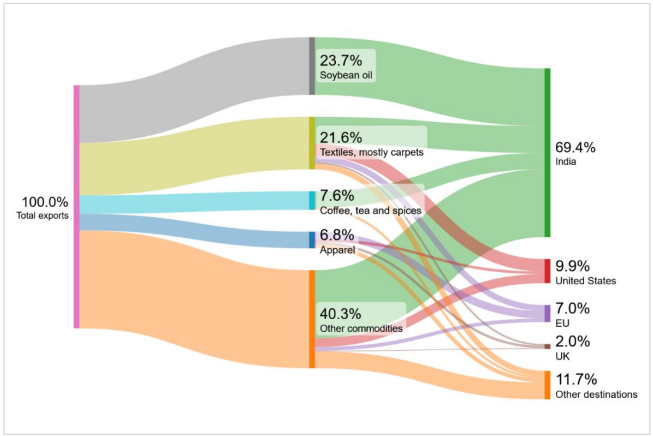
Fig 1: Nepal’s Export Structure by Product and Destination
Source: United Nations Statistics Division, UN Comtrade database; adapted from UN CDP Crisis Assessment Report for Nepal (July 2026), Appendix.
Although the data show limited impacts of the LDC graduation on overall exports, there are some underlying impacts on local employment, especially in labor-intensive industries such as carpets and garment manufacturing, where low-skilled, female, and informal workers work. An ILO (2025) study estimates that Nepal could lose up to 1.2% of total employment after the country graduates, but only under a worst-case scenario which assumes a sudden trade shock without a proper transition period or any mitigation measure.
One of the major issues resulting from the graduation is losing the flexibility to produce patented medicines without providing patent rights and paying royalties under the WTO’s Agreement on Trade-Related Aspects of Intellectual Property Rights (TRIPS). However, this consequence is not discussed explicitly in the recent CDP’s Crisis Assessment Report of Nepal. Once Nepal graduates, it would lose the given flexibility, which would increase the production cost of pharmaceutical companies in the country. The shift would make medicines more expensive and impact the lives of common people, particularly the patients who consume daily medications.
To mitigate this issue, the government can enforce provisions , with some revisions under the 2017 Intellectual Property Policy and the proposed Intellectual Property Act, permitting compulsory licensing for the domestically manufacture or import pharmaceuticals for non-commercial use. Compulsory licensing addresses the above mentioned concerns by allowing the government to authorize local generic manufacturers to produce or import patented life-saving drugs without the patent holder's consent, especially when a patent holder refuses to produce a medicine locally or license a domestic firm to do so.Therefore, the government must act urgently to domesticate the TRIPS Agreement and pass these proposed intellectual property legislations.
CDP: Confident in Criteria but Concerned About STS
As of 2026, Nepal has met all the thresholds of the graduation criteria, including the 3-year average of GNI per capita, which is $120 above the threshold. Although Nepal fulfills the criteria to graduate, it is crucial to underscore the progress report of the last STS. Around half of the actions under the STS (2024), including those related to macroeconomic stability, social inclusion, and trade, remain unimplemented. This explicitly highlights Nepal’s weak implementation capacity. Meeting the graduation criteria is only one part of the process. The actual challenge is the limited progress in implementing the STS over the past five years. At present, the ongoing Middle East Crisis risks Nepal’s remittance inflows and tourism sector, which has further increased economic uncertainties. Rather than graduation thresholds, these contemporary vulnerabilities were central to the CDP agreeing to Nepal’s deferral request and recommending an extension of the graduation timeline.
Conclusion and Recommendations
The overall statistics show that Nepal is not in a precarious situation to defer graduation as it is unlikely to have a major impact on the country’s overall trade performance as argued above. However, as highlighted by the ILO report (2025), there could be impacts on local employment, especially in labor-intensive sectors. Even these impacts are not expected to occur immediately, as Nepal will still benefit from a three-year transition period after graduation. The pharmaceutical sector would face some challenges due to changes in intellectual property obligations, but these can be addressed through appropriate legislative actions, including amendments to the Intellectual Property Act.
The key priority now is to make the best possible use of the remaining preparatory period. With a new government, hopefully stable, Nepal should maximize the benefits still available under LDC status, expand exports to markets where preferential access remains available, and make domestic industries stronger to improve their long-term competitiveness. These efforts should be complemented by a stronger focus on export promotion so that Nepal is better prepared for the post-graduation period.