Understanding China’s Soft Power: Strategies, Models, and Implications for Nepal
Pawan Adhikari


Photo Credit: The Rising Nepal
While researching on China engagement in Nepal’s civic space, I initially tried to understand the role of Chinese NGOs. My focus was to understand how these organizations operate, what kinds of projects they run, and what impact they have on Nepal’s development. As I navigated through the research it became apparent that they were just one piece of a much larger puzzle. What emerged was a picture of China’s efforts to shape its international image, build influence, and actively promote its soft power, especially in the countries of the Global South like Nepal.
Joseph Nye referred to soft power as a country’s ability to shape the preferences of others through attraction rather than coercion. Many scholarships in the west suggest that soft power emerges from culture export, promotion of democratic values, civil society engagement, and intellectual leadership. The strategies are typically decentralized and the promotion of such power rests on pluralistic influence, with a significant role placed with non-state actors such as universities, NGOs and the media.
China’s version of soft power, however, is distinct. It is state-centered, highly centralized, and closely related with the political goal of Communist Party of China (CPC). It is built around the narratives of “win-win cooperation” via development, stability, and shared possibility. In contrast to traditional soft power, China promotes “Chinese solutions” to global problems. And instead of independent civil society China’s soft power is delivered via tightly organized entities aligned with the state.
Soft power is at the center of China’s Foreign Policy. In 2007, the former President Hu Jintao declared, "The great rejuvenation of the Chinese nation will definitely be accompanied by the thriving of Chinese culture." Promotion of Chinese culture globally was central to his idea of “peaceful rise.” President Xi Jinping has taken this strategy further forward and has called for better communication of the Chinese dream. In 2014, he said, “We should increase China's soft power, give a good Chinese narrative, and better communicate China's message to the world.” Under Xi’s regime, China has employed diverse soft-power tool kit to extend its its appeal and policy influence worldwide.
China’s soft power strategy works across multiple sectors. Each instrument is part of reshaping China’s global perceptions, facilitating its global ambitions, and creating a “China-friendly” environment.
Party-to-Party Diplomacy
China’s party-to-party diplomacy is consistent with its state diplomacy but serves as a value addition to it. The International Department of the Communist Party of China (IDCPC) operates under the direct leadership of the party’s central committee to manage the party’s external relations. It has engaged with over 600 political parties and organizations over 160 countries.
Party-to-party diplomacy is often used to shape elite-level consensus in the Global South. The party cadres are trained (either at the home country or in China via exchanges), relationships are cultivated, and the expectation is that they project Chinese priorities in their local politics. Nepal is part of this strategy. Chinese party officials frequently meet with leaders from across Nepal’s political spectrum. Many party cadres, across the political spectrum but mostly leftist parties, have been to China on exchanges or visits, and are exposed to China’s model of development.
The goal of party diplomacy is to cultivate network of policy makers that are friendly to China. It is now becoming an important tool of China’s soft power projection in Nepal.
The Confucius Network and Cultural Institutions
Confucius Institutes in Nepali universities, alongside cultural centers and Mandarin language programs, promote Chinese heritage, values, and narratives. These programs present China as a civilizational power, offering cultural depth and historical continuity.
Media and Narrative Management
China’s state-run media expand Beijing’s narratives through local partnerships and multilingual content. These platforms amplify narratives of South-South solidarity, economic success, and political non-interference.
Education and People-to-People Exchanges
Belt and Road scholarship schemes, university partnerships, and elite exchange visits (targeting politicians, bureaucrats, and journalists) help build long-term networks of influence. Recipients also become informal ambassadors of the Chinese worldview.
Development Models and Alternative Norms
China’s soft power rests on state-led development, political stability, and non-interference. Chinese NGOs are a key vehicle to institutionalize state-led development model. Its Global Development Initiative (GDI) and Global Civilization Initiative (GCI) package these norms for export. These models are particularly effective in fragile and transitional states where Western models have shown limits.
China integrates soft power into its broader strategic toolkit. The party, state, business, and civic sectors often work in conjuction. This blurs the lines between diplomacy, development, and influence. Even “non-governmental” organizations operate under close political supervision.
This hybrid model allows China to project influence in a manner that is non-confrontational but deeply embedded. For example, in Nepal, soft power projects like schoolbag distributions or solar lamp installations are implemented. However, these are not merely for developmental benefit, but to build brand association and shape public sentiment. Relief support, media campaigns, and even party exchanges all feed into a single narrative. China is a benevolent partner offering an alternative path to development.
China’s soft power strategy presents both opportunities and dilemmas for geopolitically sensitive countries like Nepal.
On one hand, Chinese investment in infrastructure, development aid, or education, offers real benefits for Nepal. China’s priority of investments in green technology, rural development, “small but beautiful project,” and quick delivery development model can complement Nepal’s priorities. Cultural and educational exchanges can help understand each other better.
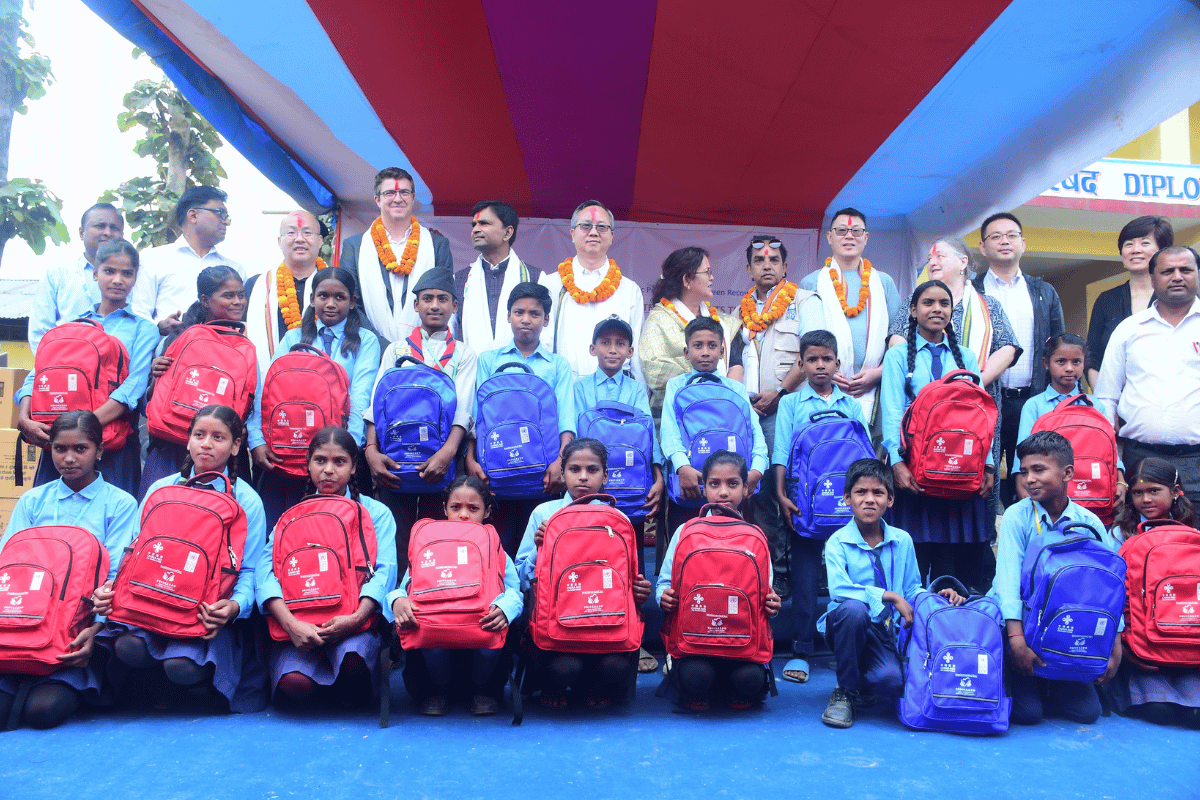
Photo Credit: CFRD Nepal via Twitter
But on the other hand, China’s soft power mechanisms are opaque and centralized. This causes legitimate concerns. Often there is limited oversight, little room for pluralism, and tendencies to bypass bureaucratic and diplomatic channel. During 2024 Kathmandu floods, the CPC directly channeled disaster relief through Nepal political parties. This shows how soft power can intersect with political influence.
Furthermore, China’s model of “soft power without liberalism” challenges the normative foundations of Nepal’s own democratic system. It normalizes a model where civil society is instrumentalized, media is managed, and state-led development is an imperative.
China’s growing soft power influence is not inherently problematic. However, it is strategic. It is meant to shape how Nepal sees China, how it engages with the world, and even how it governs itself.
Nepal must respond with strategic clarity. This means: