When a Valley Decides to Leave: Re-reading the Limi Valley Crisis
Tsogyal Wangmo Lama

I have a deep connection with Humla. My family's roots trace to the district, somewhere close to Simikot. As I remember, we never had to think about a pass to travel across the border, or worry about a monastery sitting on a fault line of melting ice. The Himalayan life used to be pleasant amid the hardships of geography. Recently when I heard that three villages of Limi- Halji, Til, and Zhang collectively decided to relocate to Takchi, I had a strong sense of sadness and loss. I read the news in a way you might hear news of a cousin you have not seen in years, yet whose name still stirs deep in your heart.
The local residents like to portray their decision as ‘shifting’ of villages, rather than abandonment of current place. I can deeply feel the attachment of locals to the ancestral land where they have lived for centuries. For the rest of the world, it can be framed as a collapse of a settlement, but for the natives they will always have deep connection with the land, although they tend to relocate. The delegation of resident from Limi Valley, in a briefing organised by CESIF Nepal about their collective decision to relocate reiterated that it’s not a matter of choice but compulsion given the climate crisis.
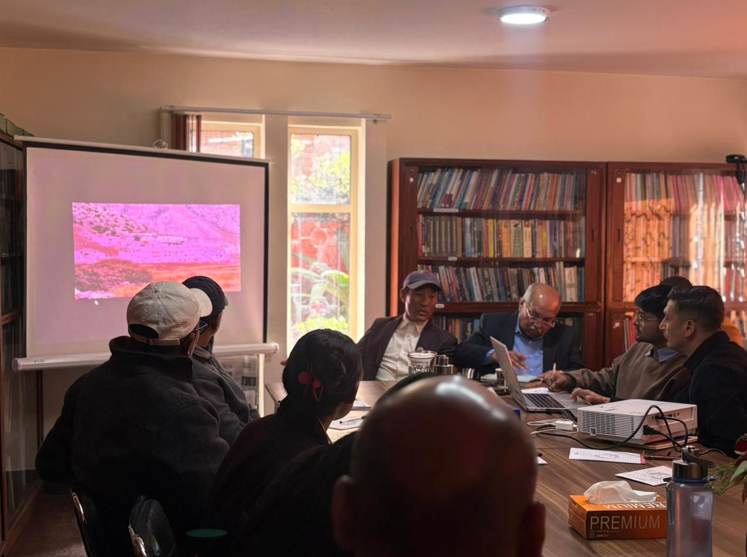
CESIF Nepal held a briefing on January 23 about the deepening crisis in Humla's Limi Valley.
The ‘remote’ narrative vs state presence
Limi sits at 3,700 to 4,100 meters along Nepal’s northern frontier bordering to Tibet. It is home to roughly 1,200 people who have been historically dependent on high-altitude farming, yak husbandry, and a trans-Himalayan trade economy that predates the Nepali state itself. It is also home to the Halji Rinchen Ling Monastery, founded in the eleventh century, one of the oldest intact monasteries in the country, and to Lapcha La Pass, the only point inside Nepal from which Mount Kailash and Lake Mansarovar are visible. I list these facts deliberately, because the government reports I have read on Humla rarely lead with them. They lead with stories of backwardness and sufferings: no road, no market, no formal healthcare. Limi and all the villages up in the mountains are often described as remote before it is described as anything it actually is. The serene Himalayan way of life, rich history and heritage, and cross-border people to people linkages are often overlooked in mainstream discourse.
And that framing matters because it shapes what kind of crisis this is allowed to be. If Limi seen only as "remote," then its depopulation can be read as inevitable, a place too far from the center to be worth holding onto. But decline of population from sixty households to two in Zang village, and Til’s loss of homes and farmland to repeated flooding, culminating in a major disaster in 2025, tells a different story. This is not a story of a place too remote to matter, but the story of communities left beyond the reach of the state, even the dangers that have been confronting them have intensified.
The flood that keeps returning
Halji village has been living with glacial lake outburst floods for two decades now. At least six GLOF events were recorded between 2004 and 2011 alone, sweeping away homes, fields, and water mills, with the 2011 flood being the most destructive. A later hydrological study of the site found the pattern to be climate-driven rather than the product of any single extreme rainfall event. This is not that a village that had one bad year. It is a village that has spent nearly its entire adult population's memory rebuilding gabion walls against a glacier that keeps threatening to a catastrophe.
What I find hard to reconcile is how a hazard this well documented, and thoroughly studied by hydrologists and geographers, has still not translated into the kind of state urgency one would expect. The knowledge exists. The warnings were there. What has been missing is the institutional will to act on it before the next flood, rather after it. Climate change may be accelerating that process, but it does not explain why some communities are left more exposed than others. That is also a question of policy, presence, and whose lives the state considers worth sustaining.
The valley was already emptying before the flood made recent headlines
Field reporting by ICIMOD in 2023 documented a second, quieter source of anxiety: Ra Rang Chu, the stream fed by a glacial lake behind the peak of Gangche. It irrigates the barley fields below the monastery but has, in living memory, swelled enough to wash away fields and houses. Villagers describe its flow becoming increasingly erratic, dwindling through the dry months, forcing them spend more time and effort channelizing enough water into the fields. The threat here is not only the sudden violence of a flood, but also the slow uncertainty of having enough water when it is needed.
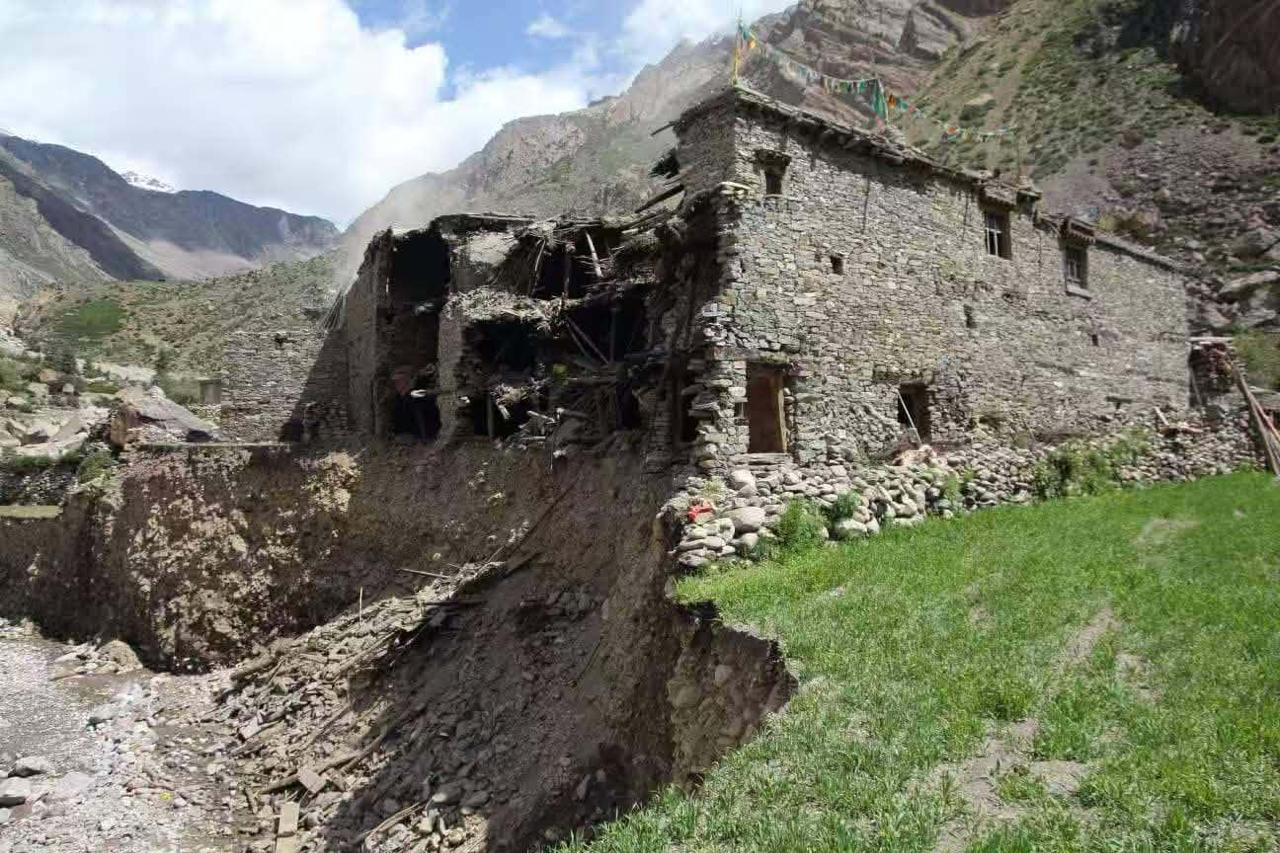
Houses destroyed due to unusual flood at Limi valley
That same report sketched a village being reshaped in quiter, slower ways. A centuries-old barter economy was giving way to cash. Warmer years had made it possible to grow radish and mustard greens where only barley had survived. The grasses that yaks depended on thinned out, pushing herds to higher pasture each year contributing to the loss of animals poorly suited to the milder winters at lower elevations.
With Simikot, Humla's own district headquarters, still unconnected to Nepal's road network and forced to transport essential goods by mule, plane, or human porter, the price of a litre of cooking oil in Halji had more than doubled in the years before report.
The village's youth were also leaving, or had already left. Many of Halji's children were already in Kathmandu, studying or working, with little incentive to return. As one resident put it, "Why would they come back? Life is tough here." Even then, the ward chair Paljor Lama was warning that Halji was the last of the three Limi villages with what he described as a healthy population, as most people from Til and Zhang had already resettled elsewhere. Read alongside Zhang's collapse from more than sixty households to only two, it becomes difficult to see the current crisis as something that arrived with a single flood. It had been building for years, in radish fields, dying yaks and children who never came home.
Unilateral Border Control and the Erosion of Cross-Border Livelihoods
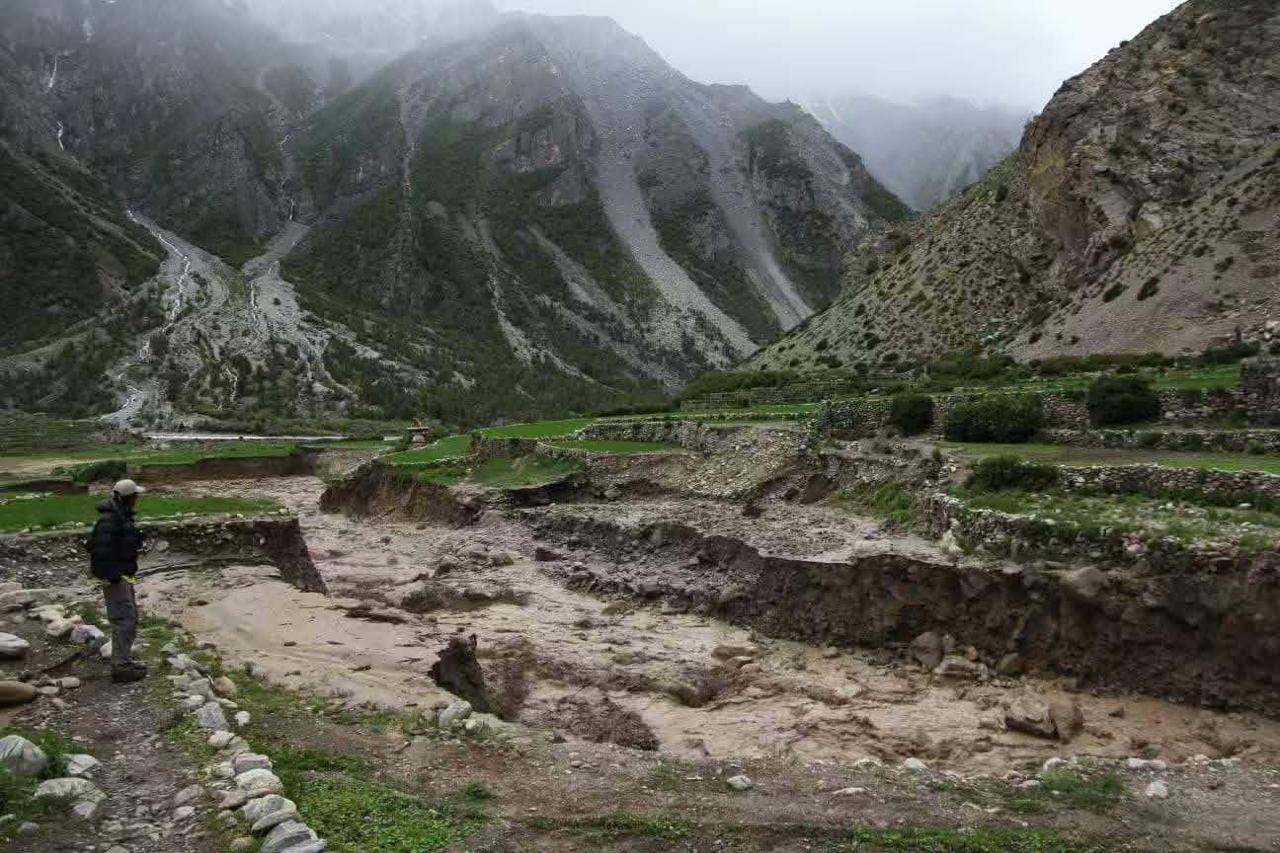
Erratic and unpredictable weather pattern has resulted unsual floods in Limi valley
The Limi crisis reveals something specific about what it means to live in a Nepali borderland. Since an agreement Nepal signed with China in 2002, residents within thirty kilometres of the frontier have been able to cross without a passport. For the people of Humla, this arrangement has long facilitated for the seasonal labor and trade in Taklakot, supporting their agropastoral economy that is never sufficient for the locals to fully sustain. But this was never a generous arrangement. It was a conditional form of access, shaped by unilateral decision made in Beijing and Purang County, without consultation with Kathmandu or Humla.
Particularly in Halji, most residents relied on daily wage work across the border in Pulan County for a decent cash income before the pandemic. While the border closed during the pandemic, the lifeline vanished overnight. Earlier ease of cross-border interactions never fully returned, while the grazing restrictions on the Chinese side further narrowed access to pasture, weakening yak husbandry just as the climate stress was already making it more difficult to sustain.
Mangal Lama, one of the local representatives puts this contradiction openly. He explains how Limi residents are denied both meaningful state support at home and sustainable access across the border. His statement points to a reality of a community stuck between two states. The community that is often overlooked by both the states when it comes to the support they needed, but constrained when it comes to the border access and movement that have made life historically feasible.
What "resettlement" is actually asking us to notice
Takchi, the site where Limi community has chosen to relocate, is not new land. It is ancestral territory, a place the Limi people already belonged to before settling in Halji, Til, and Zhang. That detail contradicts the easy narrative of climate refugees fleeing into an uncertain future. This is not flight into the unknown. It is a community exercising one of the few forms of agency still fully within their control: deciding, collectively, where within their own ancestral landscape they will go next.
I do not want to romanticize this. A "shift" that follows more than a decade of flooding, a pandemic that wiped out seasonal income, and a monastery protected by gabion walls is not a free choice in any meaningful sense. It is only the remaining choice after almost all options have been narrowed. But neither we should let the state off the hook by calling this shift inevitable. Humla, and Limi within it, has never lacked knowledge of its own risks. Village elders have watched the glacier for twenty years. The warnings have always been there, and understanding of what another flood would take away. What has been missing is a government willing to treat a borderland community's survival as urgent before displacement becomes the only word left to describe it.
As a Humla native, I have grown up hearing my own village described in the same flattening language: remote, underserved, waiting for something to arrive from outside to fix it. Reading about Limi, I recognize the pattern immediately: a place is often called a crisis only once it can no longer be ignored. By then the people who live there have spent years understanding the risks, adapting to them, and knowing what they need. The least the rest of us can do is finally listen to the actual Himalayan borderland voices and understand the reality, rather than shaping narratives from the capital.